
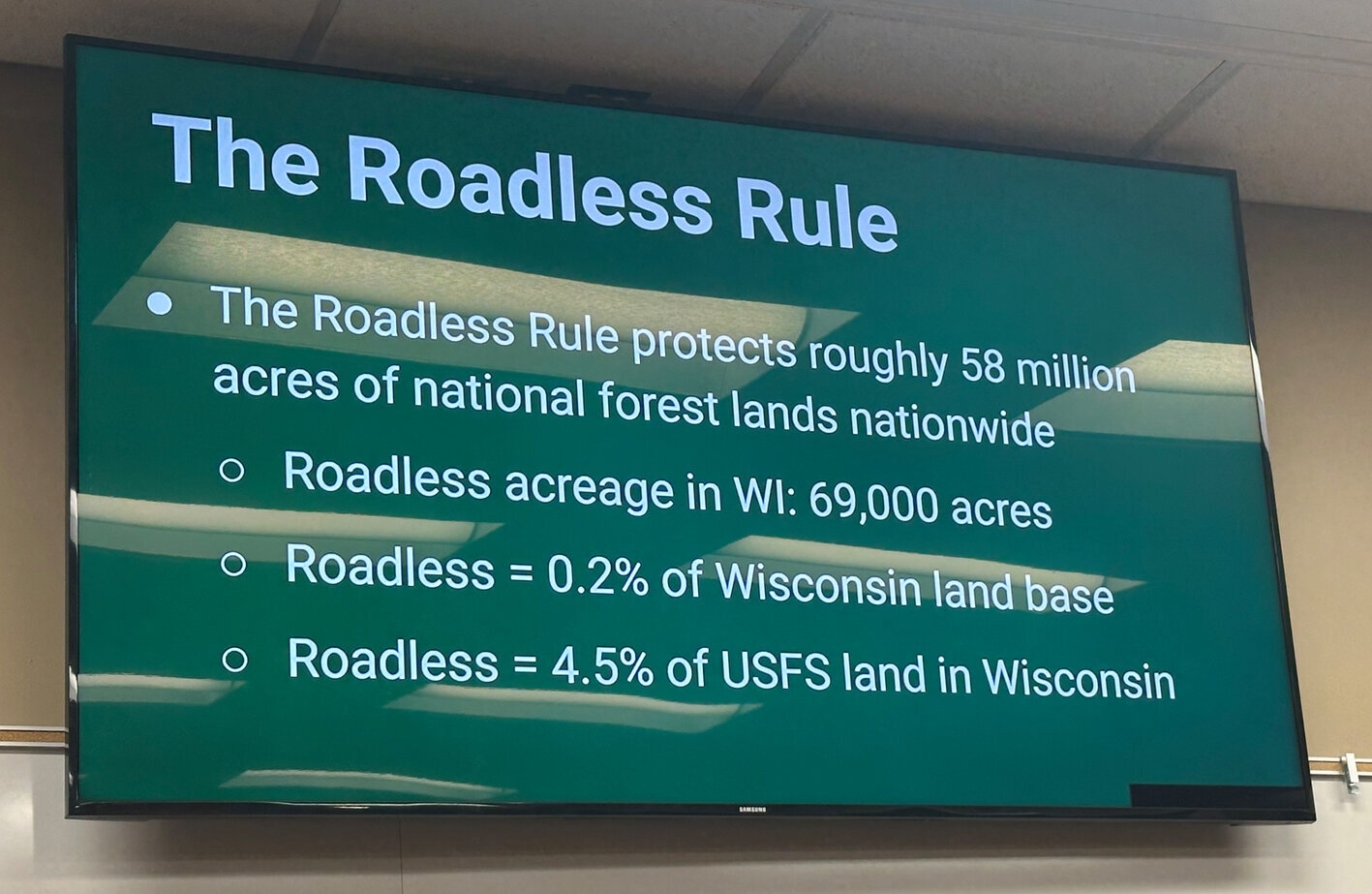
RHINELANDER – More than 100 people gathered at Nicolet College on Thursday, June 4, to voice opposition to the Trump administration’s proposal to rescind the National Roadless Rule, a 2001 regulation protecting 58 million acres of national forest land from road construction and commercial timber harvesting.
The town hall, organized by Wisconsin’s Green Fire, the Sierra Club Wisconsin Chapter, the Environmental Law and Policy Center, the League of Women Voters of the Northwoods and the Wisconsin Wildlife Federation, featured remarks from Dr. Mike Dombeck, the former chief of the U.S. Forest Service who helped craft the original rule.
Wisconsin has approximately 69,000 acres of roadless land within national forest boundaries – about 4.5% of U.S. Forest Service lands in the state – primarily within the Chequamegon-Nicolet National Forest.
Dombeck: Rescission ‘a solution looking for a problem’
Dombeck, now a University of Wisconsin System Fellow and Professor of Global Conservation, told the crowd that the administration’s stated rationales for repealing the rule – wildfire prevention and reviving the timber industry – are not supported by data.
“Eighty percent of fires that occur in the country are human ignitions, and they occur within a quarter mile of a road,” he said, adding that research has shown wildfires are four times more likely to start in roaded areas than in roadless ones.
On timber, Dombeck noted that harvest levels on the Chequamegon-Nicolet have actually increased since the 1990s, and that current market conditions – not regulation – are the primary constraint on the logging industry.
“It’s a solution looking for a problem,” he said of the proposed rescission.
He described the roadless rule as fiscally conservative, noting that it costs taxpayers nothing, creates no ongoing maintenance liability, and preserves options for future generations. The existing national forest road system – stretching 386,000 miles – already carries an $8.6 billion maintenance backlog, with only 13% of roads in good condition.
Community voices
Numerous speakers took the microphone to oppose the rollback, articulating a wide range of perspectives.
Kathleen Cooper of Oneida County Clean Waters Action cited figures showing outdoor recreation on public lands generates roughly $1.3 trillion in annual economic activity and supports 5.7 million jobs – more than 12 times the employment of coal, gas and oil combined.
“Every dollar invested in public lands returns approximately $10 in economic benefits,” she said.
Bob Martini of Rhinelander raised concern about the concurrent reduction in federal agency staffing.
“The Forest Service has lost about 35% of their professional employees,” he said, arguing that gutting environmental regulations at the top while eliminating the scientists and resource managers who enforce them compounds the threat to public lands.
Eagle River resident Heather Stricker, a former U.S. Forest Service contract employee and current Sierra Club staffer, drew on her Iowa upbringing to illustrate what’s at stake.
“Iowa is 99.9% converted to working landscapes,” she said. “We have the highest cancer rate in the country. There’s nowhere to recreate, there’s not really anywhere you’d want to fish. You don’t know what you’ve got until it’s gone.”
Emily Mae King, conservation chair for the Wisconsin Mycological Society, noted that new fungal species – some with potential medicinal value – are discovered annually in the Chequamegon-Nicolet.
“These are species that could be cancer-killing, that could save humanity,” she said, warning that road construction severs the mycelium networks that support forest biodiversity.
Larry Yeske of Verona offered a more personal appeal. Unable to hike himself due to a disability, he described bringing his family to northern Wisconsin each year and urged those in attendance to get younger generations outside and away from their screens.
He recalled a moment from a recent trip when his eight-year-old grandson stopped on a trail as the wind moved through the pines.
“You know what he said?” Larry told the crowd. “‘Nature’s talking to me.’ That’s what you want to instill in the young people.”
He asked that future generations be able to have that same experience – and that the forests be there to offer it.
What comes next
Dombeck explained that the administration is pursuing rescission through a rulemaking process, though a truncated one compared to the 18-month, 600-meeting, 1.6-million-comment process that produced the original rule.
The decision is currently under review at the Office of Information and Regulatory Affairs (OIRA).
He expressed some uncertainty about the timeline, noting that the rule’s repeal had not yet been formally announced despite expectations it would come sooner.
The original rule has survived multiple legal challenges, most recently in 2024, when it was upheld in court.
Speakers encouraged attendees to contact elected officials, attend local government meetings and vote in the fall elections. Written public comments are also being accepted as part of the federal rulemaking process.


Comments
No comments on this item Please log in to comment by clicking here